Aviation & Lodging
When the Planes Stop, the Hotels Don’t
How a nationwide aviation shutdown exposed the uneasy relationship between airline obligations, stranded travelers, and the hotels caught in between.
View the original article PDF
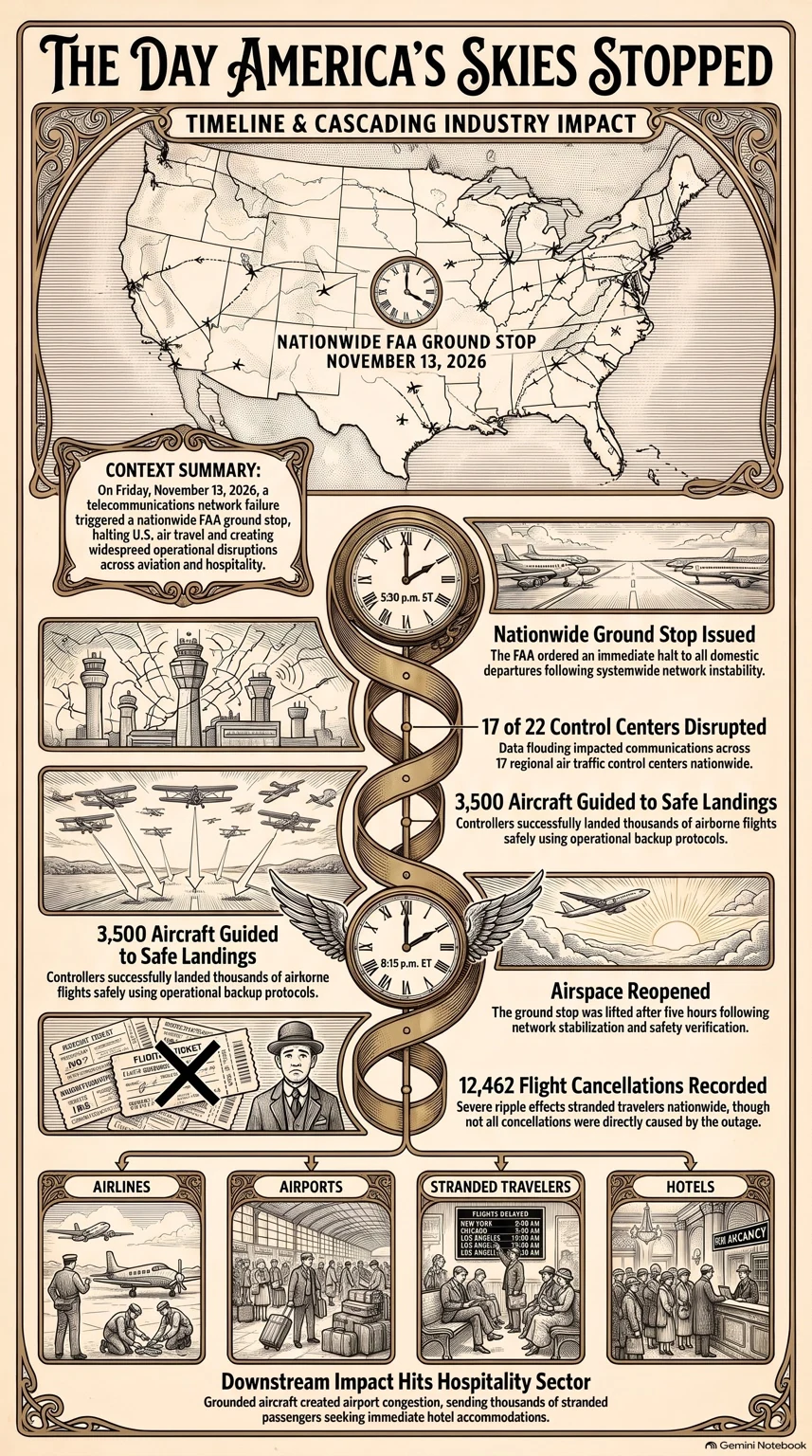
At 3:30 on a Friday afternoon, the invisible machinery of American air travel seized up.
Inside the Federal Aviation Administration’s command centers, legacy equipment buckled when an internal data flood overwhelmed telecommunications infrastructure at a rate of 1,000 connection attempts every four to five seconds. The surge destabilized critical radar feeds and air-to-ground radio frequencies across 17 of the nation's 22 regional air route traffic control centers. To protect the flying public, federal authorities took extraordinary action: an emergency nationwide ground stop.
For nearly five hours, departures across the United States were severely restricted. The system was not entirely frozen—some international flights and westbound Pacific routes received clearance to depart after individual evaluations, and controllers guided approximately 3,500 airborne commercial aircraft to safe landings. Yet the domestic passenger network slowed to an effective standstill.
By the end of Friday, November 13, commercial operators had canceled approximately 12,462 flights, including 9,082 cancellations among major carriers. While the FAA noted that not all of those cancellations were directly caused by the ground stop, the cascading logistical fallout stranded tens of thousands of ticketed travelers in terminal concourses.
Airports are built to funnel people into the sky. When departure boards turned red, those crowds surged backward into terminal lobbies, curbside pickup lanes, and hotel shuttle queues. What followed across the weekend of November 13–15 was a severe stress test of the American lodging economy—one that exposed the regulatory boundaries governing stranded travelers, pushed airport hotel corridors to capacity, and revealed a sharp operational divide between transit properties and fly-in vacation destinations.
The Accommodation Dilemma
For stranded passengers holding boarding passes for canceled flights on Friday evening, the initial assumption was that airlines would arrange their overnight accommodations.
Federal regulations, however, draw a strict distinction between mandatory ticket refunds and lodging provisions.
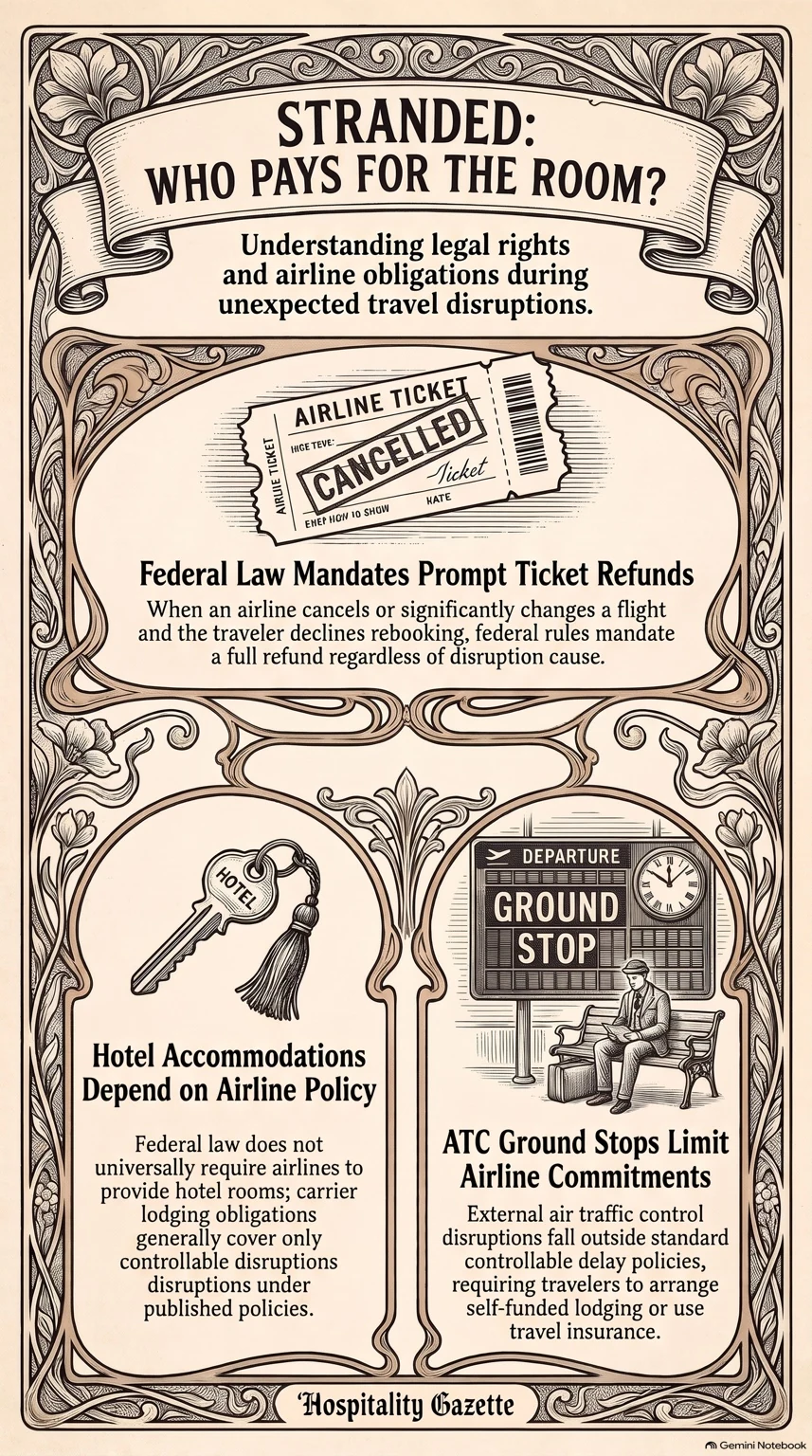
Under U.S. Department of Transportation rules, passengers have an established legal right to a prompt cash refund if an airline cancels or significantly delays a flight, regardless of the cause, provided the passenger chooses not to
accept alternative rebooking. But federal law does not universally compel carriers to supply complimentary hotel rooms or meal vouchers during disruptions.
While major U.S. airlines have individual customer-service plans pledging hotel accommodations during "controllable" disruptions—such as maintenance delays, corporate software failures, or airline crew shortages—the November 13 ground stop was an external event. Because the disruption originated within federal air traffic telecommunications infrastructure, airlines were not legally or contractually bound by their standard overnight accommodation commitments.
Although individual carriers retained discretion to offer goodwill assistance, meal vouchers, or distressed-passenger discounts, travelers facing multi-day rebooking queues were generally left to arrange and pay for rooms independently. Unless covered by third-party travel insurance or credit card trip-delay protections that required waiting out strict six- or twelve-hour delay windows, travelers bore the immediate financial responsibility for the system's breakdown.
Supply Shocks and Civic Coordination
As stranded passengers turned to their mobile devices to find lodging, the sudden displacement of demand produced starkly different regional dynamics.
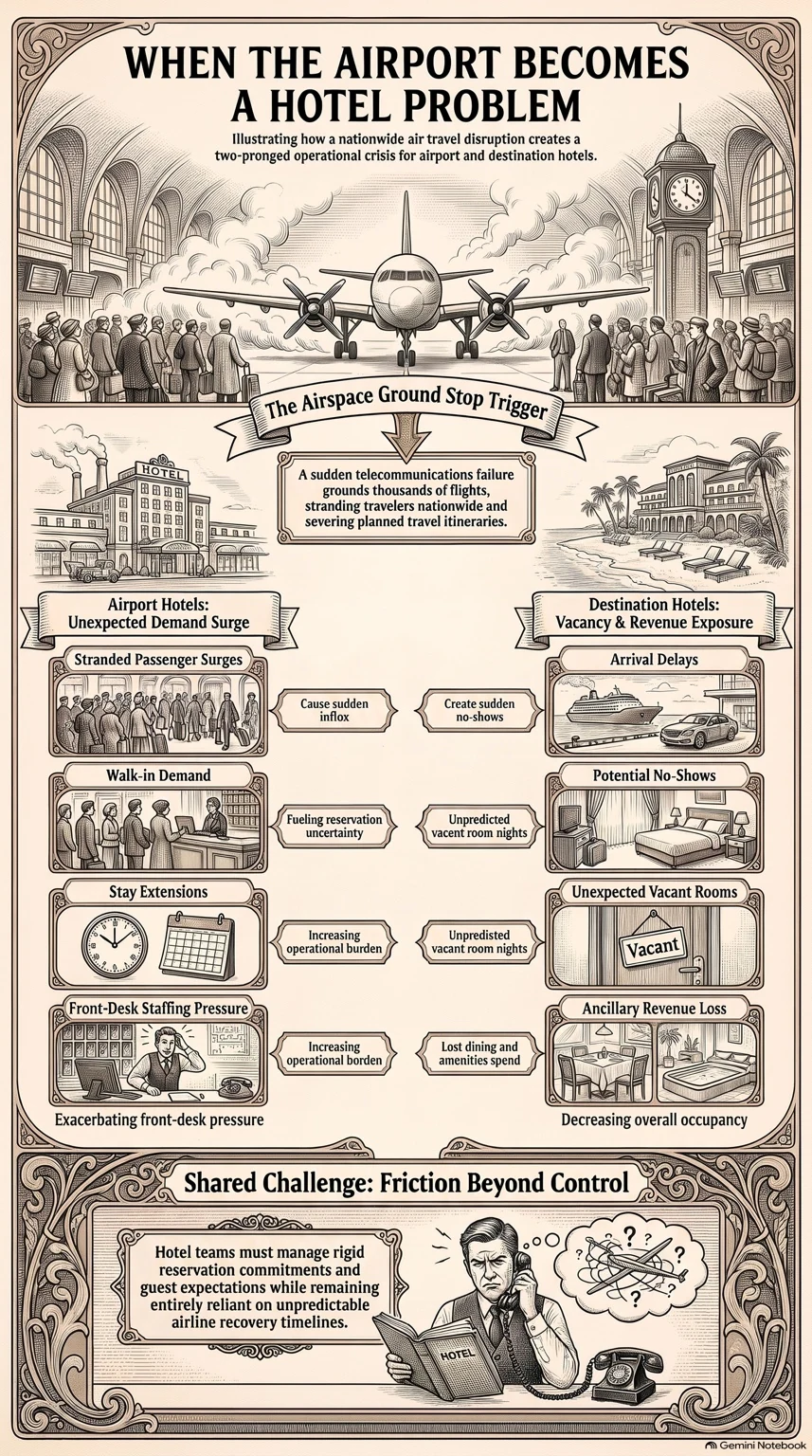
Near major hub airports, uncommitted room inventories vanished almost immediately. Travelers clustered around terminals from Los Angeles to Chicago found that proximity came at a premium. With flights grounded during peak Friday afternoon check-in, nearby airport hotels quickly filled to capacity, leaving later-arriving passengers to search miles away from the airfield or remain overnight in the terminals.
Across the country, Orlando presented a different model of response.
Orlando International Airport (MCO) recorded three consecutive days of flight disruptions: 281 flight cancellations on Friday, 232 on Saturday, and another 60 cancellations on Sunday morning as aircraft and flight crews remained scattered across the country. Rather than leaving displaced visitors entirely to their own devices, regional authorities stepped in.
The Greater Orlando Aviation Authority worked with destination marketing agency Visit Orlando to coordinate discounted hotel room blocks with participating operators, including Rosen Hotels & Resorts and Hilton Orlando. The Orlando initiative provided an organized local mechanism to connect stranded visitors with participating properties. Yet it also illustrated the broader financial reality of the weekend: participating operators offered dedicated discounted rates, but travelers were still responsible for securing and paying for those accommodations out-of-pocket because airline vouchers were not provided.
The Operational Burden on the Front Desk
Beyond headline logistics and civic coordination, the ground stop created acute operational friction inside hotel properties.
Because the FAA issued its order at 3:30 p.m. Eastern, the disruption struck during the busiest operational window of the lodging day: standard afternoon check-in. Front-office teams were caught in an informational bind. Properties
held reservations for incoming fly-in guests whose flights were delayed, diverted, or canceled, while simultaneously facing walk-in inquiries from displaced passengers seeking same-day shelter.
Because airlines spent hours adjusting flight schedules and repositioning equipment, hotel reservation managers lacked real-time visibility into whether a reserved guest was merely delayed or unable to travel entirely. Prematurely releasing a room to a walk-in guest risked turning away a guaranteed arrival who reached the property by rental car or train; holding the room indefinitely left beds empty while walk-ins were turned away.
Simultaneously, properties faced requests for unexpected stay extensions from guests already in-house whose return flights were canceled. On a Friday night in mid-November, many urban transit and resort properties were already operating near peak weekend occupancy. In hospitality operations, unscheduled extensions inevitably disrupt turnover schedules, linen cycles, and room assignments. Housekeeping departments, staffed according to anticipated checkout schedules, were forced to adjust assignments on the fly while front desks managed shifting room allocations.
These pressures were felt against a backdrop of tight operational resources. In Chicago, where air traffic groundings snarled operations at O’Hare and Midway, hundreds of hotel workers were actively striking at major properties, including the Marriott Marquis, Royal Sonesta, and The Wade Hotel, joining picketing workers at nine other downtown hotels. While there is no documented evidence that labor disputes directly hindered flight recovery efforts, the intersection of citywide strikes and air travel gridlock highlighted how vulnerable hotel operations become when external shocks hit properties operating with reduced staff.
The Industry Balance Sheet
When federal telecommunications links were stabilized at 8:15 p.m. Friday, the operational crisis did not end. Cascading crew timeouts and aircraft imbalances produced approximately 6,700 cancellations on Saturday and 2,100 on Sunday. Analysts at Bernstein estimated that the top four U.S. airlines faced a combined $345 million hit to pretax earnings.
For the hospitality industry, the financial outcome was divided.
Aviation groundings do not represent a simple net windfall for hotels. While airport properties captured sudden same-day walk-in traffic, they also managed no-show disputes, contested cancellation fees, and unexpected overtime costs. Meanwhile, fly-in leisure destinations, convention venues, and urban group hotels absorbed lost room nights, missed banquet revenues, and empty restaurant tables as incoming guests were stranded in originating cities.
The vulnerability prompted swift industry advocacy. On November 16, the U.S. Travel Association formally called on Congress to pass the Modern Skies Act, warning that systemic FAA modernization failures jeopardize air travel reliability, hotel occupancy stability, and the overall guest experience.
The November 13 ground stop demonstrated that aviation infrastructure and the hospitality economy are inextricably bound. When air traffic control systems fail, airlines can cancel flights, adjust fleets, and invoke regulatory limits on passenger lodging. But hotels must confront the human realities left behind: the travelers who still need a room, the front desks managing the confusion, and an industry that must keep operating even when the planes do not.
Sources
Federal Aviation Administration (FAA): Nationwide Ground Stop: Questions and Answers (Nov. 15, 2026) [suspicious link removed]
U.S. Department of Transportation (DOT): Aviation Consumer Protection Guidelines & Airline Cancellation Dashboard [suspicious link removed]
FOX 35 Orlando / Greater Orlando Aviation Authority (GOAA): Orlando Airport: 60 flights canceled amid FAA ground stop impacts (Nov. 15, 2026) https://www.fox35orlando.com/news/orlando-airport-60-flights-canceled-amid-faa-ground-stop-impacts
Upgraded Points: National Ground Stop Lifted, but Travel Chaos Remains: What Travelers Can Do Right Now (Nov. 13, 2026) https://upgradedpoints.com/news/faa-ground-stop-november-2026/
AFAR Media: FAA Issues Rare Nationwide Ground Stop: What Travelers Need to Know (Nov. 13, 2026) https://www.afar.com/magazine/faas-nationwide-groundstop-latest-air-travel-information
TAL Global: FAA Ground Stop: Three Questions Every CEO Should Be Asking (Nov. 18, 2026) https://talglobal.com/knowledge-center/faa-ground-stop-secure-preparedness/
CoStar News Hotels: 5 things to know for Nov. 16: US air travel disruptions expected to ease (Nov. 16, 2026) https://www.costar.com/article/1596153646/5-things-to-know-for-date
U.S. Travel Association / Travel Industry Wire: U.S. Travel Urges Congress to Pass Modern Skies Act After Nationwide Ground Stop (Nov. 16, 2026) https://www.travelindustrywire.com/article143765.html