Technology & Innovation
The Productivity Paradox
Hotel AI is getting better at doing the work. But is it making hotel work better?
View the original article PDFThe hotel industry's artificial intelligence revolution has a peculiar problem: the people celebrating its productivity gains may not be the same people experiencing them.
Software can answer guest inquiries, summarize reviews, forecast demand, organize maintenance requests, and generate reports in seconds. Technology companies describe an industry on the verge of freeing employees from repetitive work. Hotel operators see opportunities to improve service while controlling one of their largest expenses: labor.
The promise is attractive, particularly in a business where employees are routinely expected to accomplish more with less.
But a troubling question sits beneath the enthusiasm.
When artificial intelligence saves a hotel an hour of work, who gets that hour back?
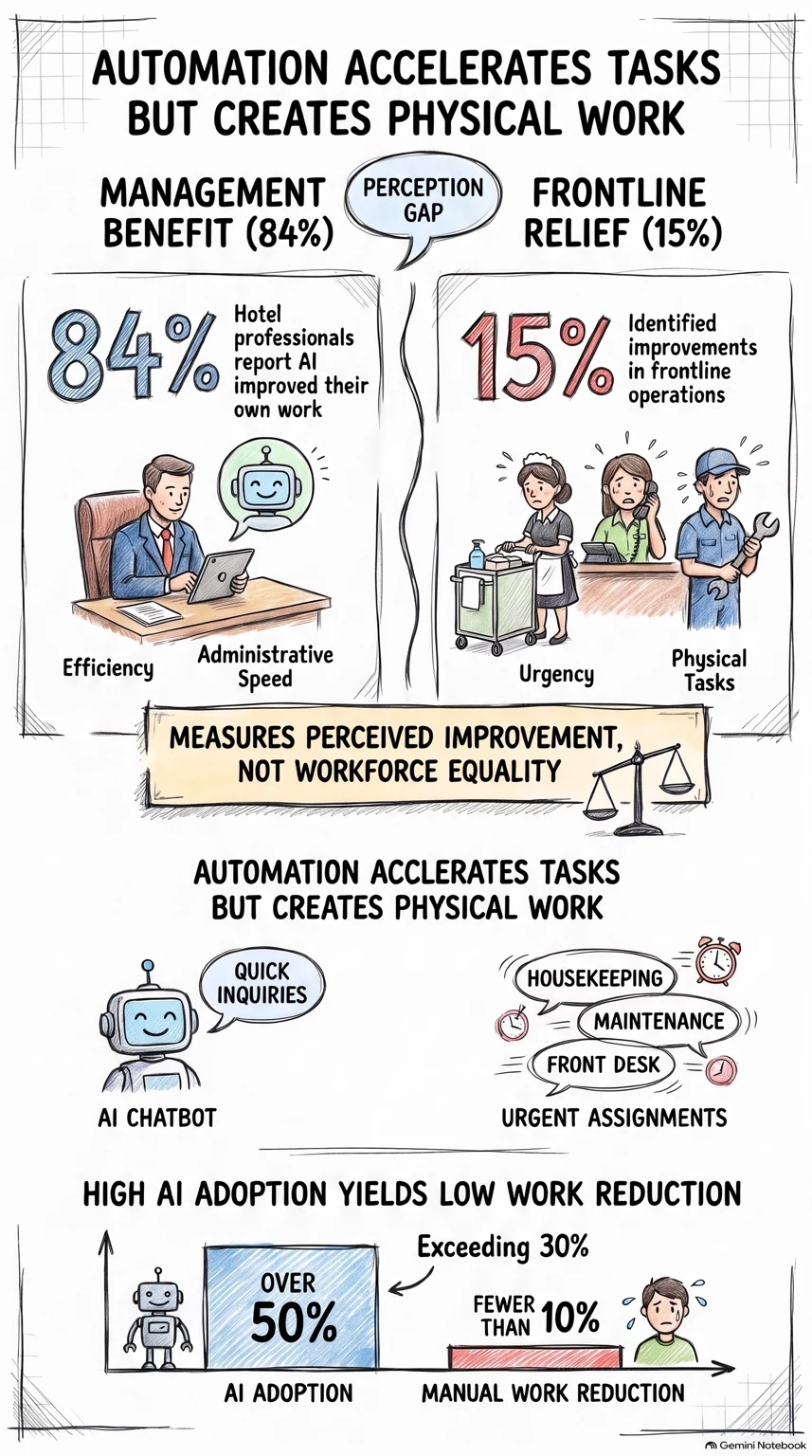
A November 2026 report from the American Hotel & Lodging Association (AHLA) and hospitality technology company Actabl offers an intriguing starting point. According to the research, 84% of respondents said AI had improved their own work, while just 15% identified improvements in frontline work.
Those numbers do not establish that managers are benefiting at employees' expense. They measure respondents' perceptions, not two independently surveyed populations of managers and frontline workers. Nor does the smaller percentage necessarily mean that 85% experienced worsening conditions; the questions concern different kinds of perceived improvement.
But the disparity raises a question that deserves more attention than another software demonstration.
The hotel industry may be getting better at measuring what AI accomplishes without adequately measuring what it changes for the people doing the work.
The View From the Executive Office
For a hotel general manager, the advantages of artificial intelligence can be immediate.
A task that once required sorting through spreadsheets, comparing reports, and drafting correspondence can increasingly be completed with software assistance. Guest feedback can be categorized, financial variances summarized, and departmental priorities organized in a fraction of the time.
These are genuine opportunities for administrative efficiency.
And the AHLA/Actabl research suggests that hotel professionals recognize them. The report found that 90% of respondents believed AI accelerated routine tasks. Operational efficiency was identified as AI's leading benefit by 38% of respondents, ahead of revenue growth at 28%.
The attraction is understandable.
Hotel management involves an extraordinary amount of information processing. Reservation patterns, labor schedules, guest complaints, maintenance activity, brand requirements, financial results, and employee performance all compete for attention.
Software that organizes this information can give managers something valuable: time to think.
But management efficiency is not necessarily operational efficiency.
A general manager might use AI to produce a more detailed daily action plan. The plan may improve accountability, identify neglected maintenance, and reveal service problems earlier.
It may also generate additional assignments for the front desk, housekeeping, and maintenance departments.
The manager's administrative burden declines. The employees' operational responsibilities increase.
Both outcomes can occur simultaneously.
Whether that represents a productivity improvement depends on what happens next.
The Front Desk Doesn't Operate in a Spreadsheet
Consider the difference between automating a guest inquiry and resolving a guest's problem.
A hotel chatbot can respond immediately to a question about checkout time. That eliminates a routine telephone call and may allow an employee to concentrate on another guest.
But when a traveler reports that the air conditioning is broken, the interaction becomes more complicated.
The software can acknowledge the complaint, create a maintenance request, notify the appropriate department, and perhaps recommend an alternative room.
Someone still has to investigate the equipment, communicate with the guest, coordinate a room move, and determine whether compensation is appropriate.
Automation has improved the movement of information. It has not necessarily eliminated the underlying work.
In some circumstances, it may make that work more visible and more urgent.
An issue that previously waited in a handwritten log can now trigger an immediate notification, an escalation, and a measurable response-time expectation.
That visibility can improve service. It can also create a more demanding working environment.
The distinction matters because hospitality is not simply a sequence of transactions.
Employees make judgment calls, manage competing priorities, and respond to circumstances that do not fit neatly into software categories.
A guest complaint may require empathy rather than speed. A housekeeping delay may reflect a complicated room condition rather than poor productivity. A maintenance request may involve an aging building whose problems cannot be solved by better task routing.
AI can help employees understand these situations.
It cannot guarantee that their organizations will give them the resources to resolve them.
The Numbers Look Promising. The Explanation Is Less Certain.
The Actabl research reported improvements in a familiar hotel operating metric: hours per occupied room.
During the first half of 2026, full-service properties using Actabl's Hotel Effectiveness tool recorded a 3.1% reduction in hours per occupied room. Select-service properties using the
tool recorded a 3.5% reduction, even as occupancy increased.
For operators, those figures matter.
Labor efficiency can determine whether a hotel protects its operating margin during periods of rising wages, uneven demand, and increasing expenses.
But a decline in hours per occupied room does not, by itself, demonstrate that artificial intelligence caused the improvement.
Hotels can reduce labor hours through tighter scheduling, changes in occupancy, cross-training, departmental restructuring, service modifications, or simply employing fewer people.
AI may contribute to some of those changes.
The published figures do not isolate its contribution.
Nor do they establish whether employees experienced lighter workloads.
A hotel that cleans the same number of rooms with fewer labor hours has become more productive according to a conventional operating measure.
Whether the housekeepers are better off is a different question.
The same distinction applies to employee turnover.
According to AHLA's release, HotelData.com's analysis of Actabl data showed hotel turnover at 5.35% in June 2026, compared with 5.84% in June 2025 and 6.07% in June 2024.
That is an encouraging trend within the reported dataset. But it does not demonstrate that AI caused employees to remain in their jobs.
The danger is not necessarily that the numbers are wrong.
It is that favorable operating trends can be mistaken for proof of a technology's effectiveness without establishing the connection.
The Adoption Gap
Another research effort complicates the picture.
In September 2026, New York University's School of Professional Studies, RateGain, and the Hospitality Electronic Distribution Network Association released The State of Distribution 2026, examining technology adoption and commercial operations across the
hotel industry.
Drawing on responses representing more than 270 hotel brands and over 58,000 properties, the research found that more than half of hotels were using or procuring generative AI.
Yet fewer than one in ten reported reductions in manual work exceeding 30%.
More than 80% of commercial teams continued spending one to two days each week producing and analyzing reports manually.
These findings concern commercial and distribution functions, not every hotel department. The survey covered revenue management, marketing, distribution, and sales, and its operating reference period preceded the report's September 2026 publication.
Nevertheless, the findings expose an important distinction.
Buying artificial intelligence is not the same as integrating it.
Integrating it is not the same as eliminating work.
And eliminating work is not the same as improving an employee's job.
Hotels often operate with multiple systems serving different purposes. Property management, revenue management, accounting, guest messaging, maintenance, and labor scheduling may function across separate platforms.
AI can analyze information within those systems, but its usefulness depends on data quality, connectivity, permissions, and the ability to turn recommendations into operational decisions.
A sophisticated tool layered onto fragmented infrastructure may simply become another system employees must manage.
The industry is not necessarily confronting a shortage of technological capabilities.
It may be confronting a shortage of operational integration.
The Automation Success Stories
There is credible evidence that AI can perform substantial volumes of hotel work.
The difficulty is determining what those achievements mean for the business—and for employees.
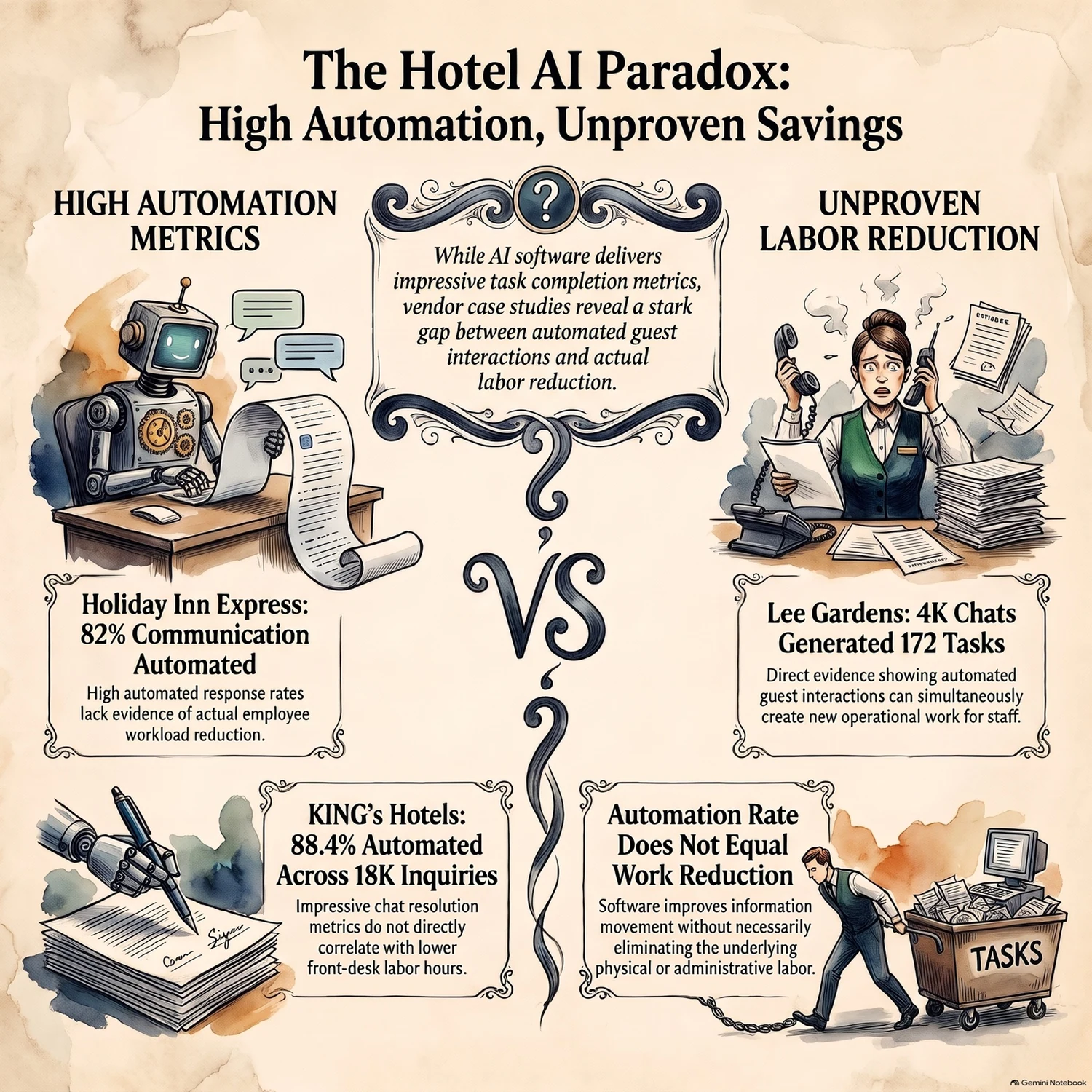
At the 156-room Holiday Inn Express & Suites at Orlando's SeaWorld, hospitality technology provider Canary Technologies reported that its system automated 82% of guest communications during the first four months of implementation.
The property's general manager, Mason Caracciolo, credited the technology with reducing repetitive inquiries and allowing employees to concentrate on more complex guest needs.
That is a meaningful endorsement from an operator, although the results are documented in a vendor-published case study rather than an independent evaluation of employee workloads.
At KING's Hotels in Munich, HiJiffy reported handling approximately 18,000 conversations between January and May 2025, with an 88.4% automation rate across communication channels and an 89% chatbot customer-satisfaction score.
Hanna King, the company's chief executive, described a shift away from repetitive messaging toward more personal guest interaction.
These examples suggest that routine guest communications are a promising application for hotel AI.
They also demonstrate the limits of automation metrics.
An 88% automation rate does not mean that a hotel reduced its front-desk labor expense by 88%. Nor does it establish that employees spent 88% less time handling guest communications.
Some conversations might never have reached an employee in the first place. Others might have generated follow-up work. The remaining inquiries may have been more complicated than those the software resolved.
The distinction is especially important when technology providers present automated conversations as evidence of labor savings.
At Lee Gardens Extended Stay in Orlando, AI provider Una by Polydom reported $80,968 in direct booking revenue associated with 232 reservations made through its system over ten months.
The same case study reported 4,104 guest conversations and 172 operational tasks generated for hotel employees.
That final figure is particularly interesting.
It illustrates how automation can simultaneously handle guest interactions and create work for hotel personnel.
There is nothing inherently wrong with that arrangement. A system that identifies previously overlooked guest needs may improve service even when it generates additional tasks.
But it challenges the assumption that more automation necessarily means less work.
The business case depends on the value of the resulting activity, not merely how much software performs.
The Cost of Getting It Wrong
Artificial intelligence is often marketed as a solution to the hospitality industry's labor challenges.
But labor is not simply an expense to be minimized. It is also the operating capacity through which a hotel delivers its product.
A property can reduce staffing to the point that conventional productivity measures improve while service quality deteriorates.
Fewer employees may produce lower payroll costs, but they can also produce longer waits, deferred maintenance, inconsistent housekeeping, and greater pressure on the people who remain.
Technology can make those employees more effective.
It cannot indefinitely compensate for insufficient operating capacity.
That is why the financial evaluation of AI requires more than comparing subscription costs with estimated labor savings.
Implementation can involve software integration, employee training, technical support, process redesign, and ongoing supervision.
Automated systems also make mistakes. Guest communications require accuracy. Reservations must be handled correctly. Operational recommendations must reflect the property's actual circumstances.
The true return on investment depends on whether the technology improves the total cost and quality of service.
For hotel ownership groups and management companies, this creates an uncomfortable possibility.
An AI deployment may be successful at automating tasks without being successful at improving the operation.
Those are different achievements.
A Warning From the People Using It
A 2026 British government study of AI adoption offers a useful counterpoint to the industry's promotional narrative.
Among its case studies was a mid-sized hotel using AI to assist with administrative work and the analysis of guest reviews.
Management identified useful applications, but the reported time savings from AI-assisted review responses were modest.
The hotel had also acquired a service robot intended to help move plates between dining areas and the kitchen. The robot was not operational because its sensors could not navigate the property's doorways.
Employees had reportedly expressed concerns about the robot's implications for their jobs.
AI use was concentrated among senior management and reception personnel, while broader adoption encountered organizational resistance.
The case does not establish that hotel employees generally oppose artificial intelligence.
It illustrates something more specific: technological capability does not automatically translate into organizational acceptance or meaningful improvements in working conditions.
A machine purchased to reduce manual work may accomplish nothing if it cannot navigate the building. A software tool adopted enthusiastically by management may have limited practical value to employees working elsewhere in the operation.
Employees are not simply the recipients of technological transformation.
They are the people expected to make it function.
A hotel can purchase software without securing the confidence of the people who must use it. It can announce an automation initiative without clearly explaining how jobs will change. It can celebrate efficiency gains while leaving employees uncertain about whether those gains threaten their hours or positions.
That uncertainty is itself an operational consideration.
Successful implementation requires more than functional technology. It requires a convincing answer to what the technology is supposed to accomplish for the people using it.
The Productivity Dividend
The central question is not whether hotels should adopt artificial intelligence.
They already are.
Nor is it whether the technology can perform useful work. Evidence from guest communications, administrative processing, and commercial operations indicates that it can.
The unresolved question is how the benefits are distributed.
Imagine that AI eliminates ten hours of repetitive administrative work from a hotel each week.
Management could use those hours to reduce payroll expense.
It could preserve staffing and redirect employees toward guest service.
It could increase operational expectations without changing staffing.
Or it could combine those approaches.
The technology does not decide.
Ownership and management do.
That is where the productivity paradox becomes a question of leadership rather than software.
An organization that treats every efficiency gain as an opportunity to reduce labor may produce a different employee experience from one that uses the same technology to improve service, training, and operational resilience.
Both organizations may report successful automation.
Only one may be making hotel work meaningfully better.
What the Industry Still Has to Prove
The strongest evidence supporting hotel AI concerns its ability to process information, automate repetitive interactions, and accelerate administrative tasks.
The evidence becomes less definitive when the claims move toward lower labor costs, improved retention, reduced employee stress, and better working conditions.
That does not mean those benefits are imaginary.
It means they require different measurements.
A hotel that claims AI has improved productivity should be able to explain what happened to labor hours, employee responsibilities, service quality, and operating costs after
implementation.
A vendor that claims to save employees time should be able to distinguish between automated transactions and work actually removed from the employee's day.
And an industry celebrating artificial intelligence as a workforce solution should be interested in whether frontline employees share that assessment.
The November AHLA/Actabl findings make this question difficult to ignore.
If respondents overwhelmingly recognize improvements in their own work but identify far fewer improvements in frontline operations, the industry has reason to examine what happens between the executive office and the guest-room corridor.
The productivity revolution may be real.
But productivity is not the same as progress.
A faster hotel is not necessarily a better hotel. A cheaper operation is not necessarily a healthier one. And an employee who can accomplish more is not necessarily an employee whose work has become easier.
Artificial intelligence may ultimately give the hotel industry something it has wanted for decades: the ability to deliver better hospitality with fewer repetitive tasks and more informed decisions.
Whether that promise becomes reality will depend less on how sophisticated the software becomes than on what hotel companies do with the time, money, and operational capacity it creates.
Because the most important measure of hotel AI may not be how much work it can do.
It may be how much better it allows people to work.
Sources and reporting
American Hotel & Lodging Association and Actabl — AI and the Hotel Workforce, November 2026
NYU SPS / RateGain / HEDNA — The State of Distribution 2026
UK Government — Artificial Intelligence Adoption Research 2026
Canary Technologies — Holiday Inn Express & Suites at Orlando's SeaWorld case study
HiJiffy — KING's Hotels case study
Una by Polydom — Lee Gardens Extended Stay case study
Vendor case-study figures are attributed to their publishers and are not represented as independently audited outcomes.